
Case study · experimental browser game
Starship Swarm
“Fit a battered ship, take a job, and bring the useful bits home. The local aliens would prefer you left the ship too.”
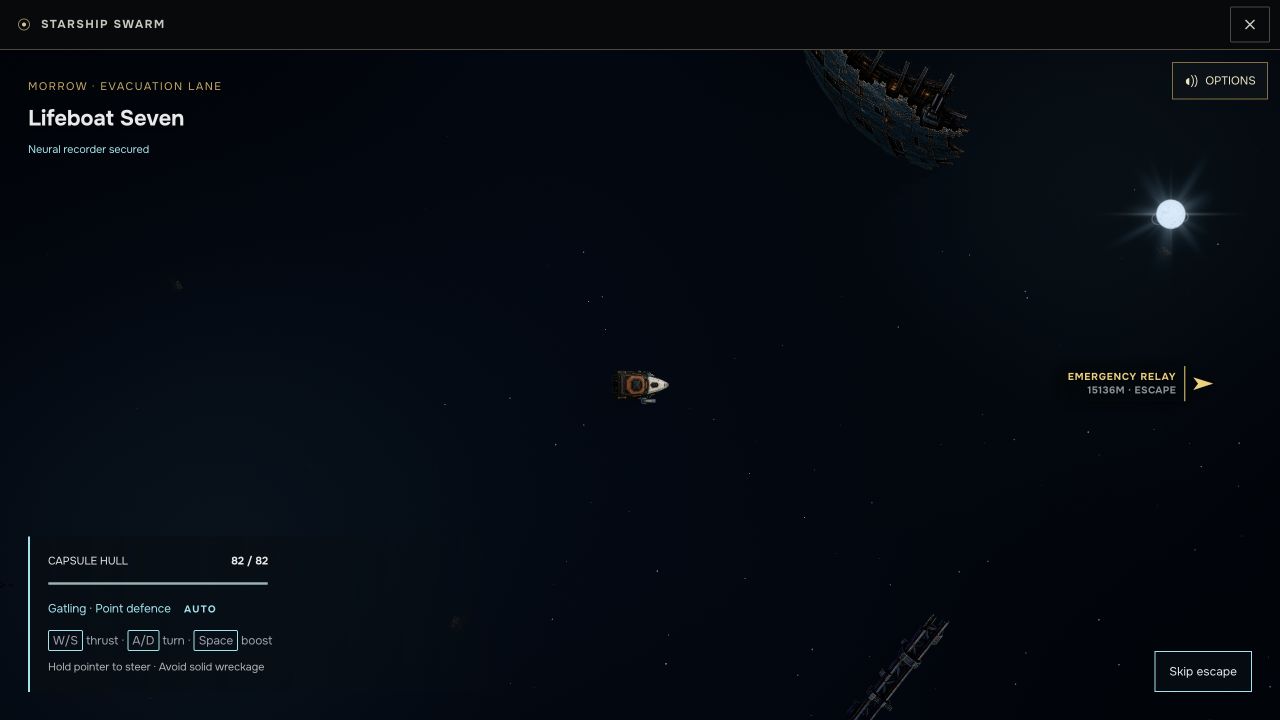
Starship Swarm is an experiment in iteration speed: how quickly a game can go from an idea to a playable, measured change. It runs in the browser, so every build is one link away from players.
- Hull types
- 13
- Ship classes
- 5
- Ship modules
- 58
- Story beats
- 51
Figures from the public build on 8 October 2026.
01
Designed as data
Ships, modules and story beats live in data rather than code. Every module is defined by its purpose, what it excels against and its trade-off. That keeps the 58 options distinct, and it makes a balance change an edit rather than a rebuild.
Point defence turret
A rapid interceptor that prioritises incoming ordnance, then turns on small craft when the sky is clear.
- Purpose
- Rapidly intercept urgent ordnance, then suppress nearby small craft.
- Excels against
- Individual missiles, rockets and close light fighters.
- Trade-off
- Low damage against ordinary and armoured ships.
02
Measured, then changed
A live leaderboard, live player counts and a private stats dashboard show how people actually play. The design changes as the data comes in: scoring is already on its third version.
- Live leaderboardTop sortie scores, shown beside the game
- Scoring model v3The third version of how a sortie is scored
- Player countWho is flying right now
- Stats dashboardPrivate analytics for design decisions
03
Art at the speed of design
Art comes from repeatable generation workflows, so new hulls and modules can be visualised as quickly as they are designed, and regenerated when the design changes.
04
Experiments that branch
Bigger ideas split into their own playtests. X4, an experimental build, grew into a wider galaxy: explore, haul cargo, get home. In its own words, the galaxy experiment got a bit out of hand.
What it shows
Systems design, data-led balance, analytics, art pipelines and fast iteration, in one small game. The same practices are written up as skills you can use.